 Add to Chrome
 Add to Firefox
 Add to Edge
SAFE-Pruner: Semantic Attention-Guided Future-Aware Token Pruning for Efficient Vision-Language-Action Manipulation
May 28, 2026
Real-time inference of vision-language-action (VLA) models is essential for robotic control. While visual token pruning has shown strong potential for accelerating inference, most existing methods mainly base pruning decisions on shallow-layer cues and risk discarding visual information required by deep layers. To address this issue, we propose SAFE-Pruner, a plug-and-play pruning framework that incorporates attention cues of future layers into pruning decisions. Specifically, we identify semantic attention consistency, the tendency that VLA models concentrate their attention probability mass on the same semantic entity across execution steps. Based on this observation, we design a forward-looking strategy to forecast the token saliency in deep layers, which prevents the premature removal of critical tokens and leads to more stable acceleration. We further introduce an adaptive subtask division strategy to detect abrupt attention shifts, thereby improving forecasting accuracy and pruning reliability. Extensive experiments in simulation and real-world settings demonstrate that our method achieves up to 1.89x speedup with a minimal degradation in success rate of less than 1.7%, while outperforming state-of-the-art methods by up to 1.9%.

Adversarial Dual On-Policy Distillation from Expressive Flow-based Teacher
May 26, 2026Learning from demonstrations in embodied control is often cast as behavioral cloning, and recent diffusion or flow-matching policies improve this paradigm by modeling multi-modal expert actions. Yet these methods remain offline supervised learners: the policy is trained only on expert states and receives no corrective signal on the states it actually visits. On-policy distillation (OPD) offers a natural remedy, but standard OPD assumes a strong fixed teacher, which is unavailable in demonstration-only control. We propose \textbf{FA-OPD}, an \emph{adversarial dual on-policy distillation} method in which a Flow Matching (FM) teacher is learned from demonstrations and co-trained with a lightweight MLP student. The teacher provides two complementary signals on student rollouts. The reward channel learns an expert-likeness objective over state-action pairs and drives online exploration through long-horizon policy optimization. The action channel supplies dense local targets at student-visited states, stabilizing exploitation. FA-OPD couples them so that reward distillation enables generalization beyond point-wise demonstrations, while action distillation keeps exploration anchored near expert-like behavior. Across six robot navigation, manipulation, and locomotion benchmarks, FA-OPD beats strong baselines and shows much stronger robustness under noisy or limited demonstrations.
StableVLA: Towards Robust Vision-Language-Action Models without Extra Data
May 18, 2026It is infeasible to encompass all possible disturbances within the training dataset. This raises a critical question regarding the robustness of Vision-Language-Action (VLA) models when encountering unseen real-world visual disturbances, particularly under imperfect visual conditions. In this work, we conduct a systematic study based on recent state-of-the-art VLA models and reveal a significant performance drop when visual disturbances absent from the training data are introduced. To mitigate this issue, we propose a lightweight adapter module grounded in information theory, termed the Information Bottleneck Adapter (IB-Adapter), which selectively filters potential noise from visual inputs. Without requiring any extra data or augmentation strategies, IB-Adapter consistently improves over the baseline by an average of 30%, while adding fewer than 10M parameters, demonstrating notable efficiency and effectiveness. Furthermore, even with a 14x smaller backbone (0.5B parameters) and no pre-training on the Open X-Embodiment dataset, our model StableVLA achieves robustness competitive with 7B-scale state-of-the-art VLAs. With negligible parameter overhead (<10M), our approach maintains accuracy on long-horizon tasks and surpasses OpenPi under both synthetic and physical visual corruptions.
CLAP: Contrastive Latent Action Pretraining for Learning Vision-Language-Action Models from Human Videos
Jan 07, 2026Generalist Vision-Language-Action models are currently hindered by the scarcity of robotic data compared to the abundance of human video demonstrations. Existing Latent Action Models attempt to leverage video data but often suffer from visual entanglement, capturing noise rather than manipulation skills. To address this, we propose Contrastive Latent Action Pretraining (CLAP), a framework that aligns the visual latent space from videos with a proprioceptive latent space from robot trajectories. By employing contrastive learning, CLAP maps video transitions onto a quantized, physically executable codebook. Building on this representation, we introduce a dual-formulation VLA framework offering both CLAP-NTP, an autoregressive model excelling at instruction following and object generalization, and CLAP-RF, a Rectified Flow-based policy designed for high-frequency, precise manipulation. Furthermore, we propose a Knowledge Matching (KM) regularization strategy to mitigate catastrophic forgetting during fine-tuning. Extensive experiments demonstrate that CLAP significantly outperforms strong baselines, enabling the effective transfer of skills from human videos to robotic execution. Project page: https://lin-shan.com/CLAP/.
DSPv2: Improved Dense Policy for Effective and Generalizable Whole-body Mobile Manipulation
Sep 19, 2025Learning whole-body mobile manipulation via imitation is essential for generalizing robotic skills to diverse environments and complex tasks. However, this goal is hindered by significant challenges, particularly in effectively processing complex observation, achieving robust generalization, and generating coherent actions. To address these issues, we propose DSPv2, a novel policy architecture. DSPv2 introduces an effective encoding scheme that aligns 3D spatial features with multi-view 2D semantic features. This fusion enables the policy to achieve broad generalization while retaining the fine-grained perception necessary for precise control. Furthermore, we extend the Dense Policy paradigm to the whole-body mobile manipulation domain, demonstrating its effectiveness in generating coherent and precise actions for the whole-body robotic platform. Extensive experiments show that our method significantly outperforms existing approaches in both task performance and generalization ability. Project page is available at: https://selen-suyue.github.io/DSPv2Net/.
VLA-RL: Towards Masterful and General Robotic Manipulation with Scalable Reinforcement Learning
May 24, 2025
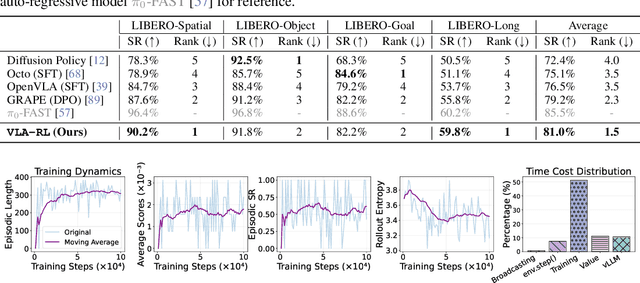
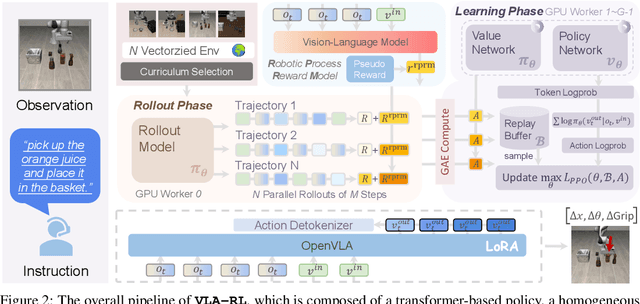
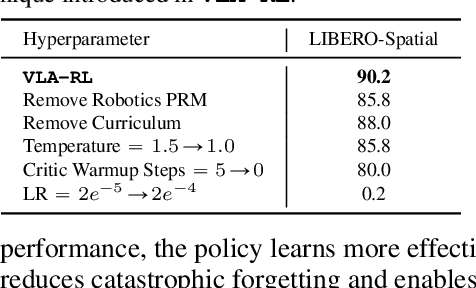
Recent high-capacity vision-language-action (VLA) models have demonstrated impressive performance on a range of robotic manipulation tasks by imitating human demonstrations. However, exploiting offline data with limited visited states will cause execution failure in out-of-distribution scenarios. Intuitively, an exploration-based method that improves on online collected data at test time could address this limitation. We present VLA-RL, an algorithmic and systematic framework that leverages online reinforcement learning (RL) to improve pretrained auto-regressive VLAs in downstream tasks. Within a unified perspective, we first introduce a trajectory-level RL formulation for auto-regressive VLA training, which models general robotic manipulation trajectory as multi-modal multi-turn conversation. To address the challenge of sparse rewards, we fine-tune a pretrained vision-language model as a robotic process reward model, which is trained on pseudo reward labels annotated on automatically extracted task segments. To scale up, we identify several implementation findings that improve the stability and efficiency including curriculum selection strategy, GPU-balanced vectorized environments, batch decoding, and critic warmup. VLA-RL enables OpenVLA-7B to surpass the strongest finetuned baseline by 4.5% on 40 challenging robotic manipulation tasks in LIBERO, and even matches the performance of advanced commercial models such as $\pi_0$-FAST. Notably, we observe that VLA-RL benefits from increased test-time optimization, indicating an early spark of inference scaling laws in robotics.
GeoLRM: Geometry-Aware Large Reconstruction Model for High-Quality 3D Gaussian Generation
Jun 21, 2024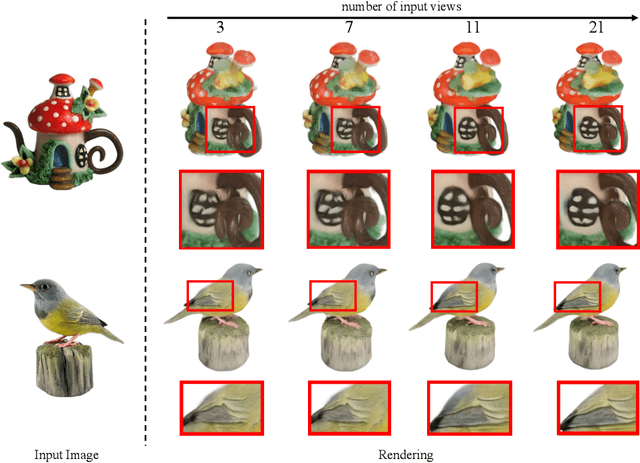
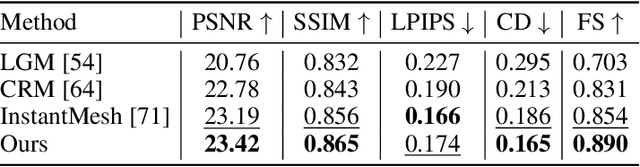
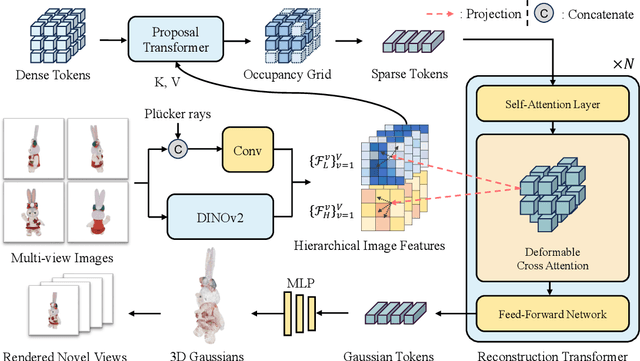

In this work, we introduce the Geometry-Aware Large Reconstruction Model (GeoLRM), an approach which can predict high-quality assets with 512k Gaussians and 21 input images in only 11 GB GPU memory. Previous works neglect the inherent sparsity of 3D structure and do not utilize explicit geometric relationships between 3D and 2D images. This limits these methods to a low-resolution representation and makes it difficult to scale up to the dense views for better quality. GeoLRM tackles these issues by incorporating a novel 3D-aware transformer structure that directly processes 3D points and uses deformable cross-attention mechanisms to effectively integrate image features into 3D representations. We implement this solution through a two-stage pipeline: initially, a lightweight proposal network generates a sparse set of 3D anchor points from the posed image inputs; subsequently, a specialized reconstruction transformer refines the geometry and retrieves textural details. Extensive experimental results demonstrate that GeoLRM significantly outperforms existing models, especially for dense view inputs. We also demonstrate the practical applicability of our model with 3D generation tasks, showcasing its versatility and potential for broader adoption in real-world applications.
OccNeRF: Self-Supervised Multi-Camera Occupancy Prediction with Neural Radiance Fields
Dec 14, 2023


As a fundamental task of vision-based perception, 3D occupancy prediction reconstructs 3D structures of surrounding environments. It provides detailed information for autonomous driving planning and navigation. However, most existing methods heavily rely on the LiDAR point clouds to generate occupancy ground truth, which is not available in the vision-based system. In this paper, we propose an OccNeRF method for self-supervised multi-camera occupancy prediction. Different from bounded 3D occupancy labels, we need to consider unbounded scenes with raw image supervision. To solve the issue, we parameterize the reconstructed occupancy fields and reorganize the sampling strategy. The neural rendering is adopted to convert occupancy fields to multi-camera depth maps, supervised by multi-frame photometric consistency. Moreover, for semantic occupancy prediction, we design several strategies to polish the prompts and filter the outputs of a pretrained open-vocabulary 2D segmentation model. Extensive experiments for both self-supervised depth estimation and semantic occupancy prediction tasks on nuScenes dataset demonstrate the effectiveness of our method.
Semantic Ray: Learning a Generalizable Semantic Field with Cross-Reprojection Attention
Mar 23, 2023In this paper, we aim to learn a semantic radiance field from multiple scenes that is accurate, efficient and generalizable. While most existing NeRFs target at the tasks of neural scene rendering, image synthesis and multi-view reconstruction, there are a few attempts such as Semantic-NeRF that explore to learn high-level semantic understanding with the NeRF structure. However, Semantic-NeRF simultaneously learns color and semantic label from a single ray with multiple heads, where the single ray fails to provide rich semantic information. As a result, Semantic NeRF relies on positional encoding and needs to train one specific model for each scene. To address this, we propose Semantic Ray (S-Ray) to fully exploit semantic information along the ray direction from its multi-view reprojections. As directly performing dense attention over multi-view reprojected rays would suffer from heavy computational cost, we design a Cross-Reprojection Attention module with consecutive intra-view radial and cross-view sparse attentions, which decomposes contextual information along reprojected rays and cross multiple views and then collects dense connections by stacking the modules. Experiments show that our S-Ray is able to learn from multiple scenes, and it presents strong generalization ability to adapt to unseen scenes.